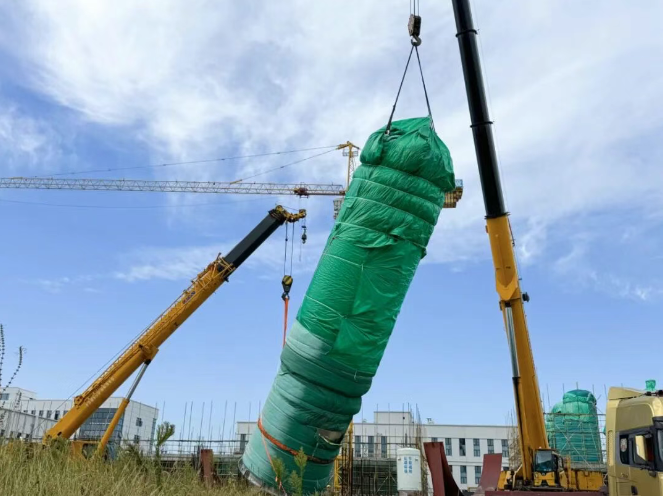
Recently, all twelve 75-ton fermentation tanks at Langou Phyton (Jiangsu) Biopharmaceutical Co., Ltd. have been successfully hoisted and installed in their designated positions, marking a major milestone in the construction of the world's leading Plant Cell Fermentation (PCF®) superfactory. These large-scale fermentation tanks will be used for the industrial production of high-value pharmaceutical ingredients derived from rare medicinal plants, including paclitaxel and rare ginsenosides. Through meticulous preliminary planning, the project team effectively overcame the technical challenges associated with transporting and installing large equipment, ensuring that all fermentation tanks were accurately positioned according to the required specifications and paving the way for subsequent operations. With the core equipment now in place, civil construction work on the production workshops will proceed rapidly, laying a solid foundation for future full-scale production.
The Langou Phyton PCF® Plant Cell Fermentation Superfactory Project has a planned total investment of RMB 3 billion. The project covers approximately 133,000 square meters of land, with a total planned building area of approximately 155,000 square meters. Its major facilities include an R&D and pilot-scale production platform, a paclitaxel fermentation workshop, a multifunctional plant active ingredient fermentation workshop, a purification workshop, a health food production workshop, and a medical aesthetics product workshop. The company's product portfolio will encompass single-component active pharmaceutical ingredients (APIs), multi-component APIs, functional foods, health foods, medical aesthetics products, and innovative pharmaceutical formulations.
Plant Cell Fermentation (PCF®) is a biotechnology that utilizes plant cells cultivated in bioreactors under specific process conditions to achieve the industrial-scale production of targeted active ingredients. The process mainly involves the following steps: First, callus tissue is induced from plant material, and individual cells are isolated from the callus. Through repeated isolation and cultivation, superior cell lines with a high capacity to synthesize the desired compounds are selected. Clonal cell lines are then established and preserved for subsequent industrial production. Next, the selected high-performing cell lines undergo successive stages of culture expansion, progressing from initial cultivation to flask culture and then through multiple fermentation stages. Finally, the cells are transferred into fermentation tanks with capacities of 75,000 liters or more to produce the desired target compounds.
Compared with conventional plant extraction methods, PCF® technology is environmentally friendly, safe, and reliable. It overcomes the dependence of traditional cultivation on land and climatic conditions, enables the targeted accumulation and clean production of active ingredients, and effectively addresses challenges such as inconsistent concentrations of plant-derived active compounds, limited production yields, and low active ingredient content. The technology has also received the U.S. Presidential Green Chemistry Challenge Award.

Driven by the growing demand for health and wellness solutions, Langou Phyton will leverage its globally leading PCF technology and focus on the rapidly developing field of synthetic biology. With plant cell fermentation as its core strength, the company aims to establish a global industrialization platform for synthetic biology that also incorporates animal-derived and microbial cell technologies. Through technological innovation and sustainable development, Langou Phyton is committed to becoming a global leader in green intelligent manufacturing.